


A daily hazard
Forklift pedestrian detection systems exist because of a risk that never really goes away, a forklift and a person working on the same floor. It happens thousands of times a day in warehouses, distribution centres and yards, and almost always nothing comes of it. The trouble is the exception.
Workplace transport is one of the areas the Health and Safety Executive watches most closely. Being hit by a moving vehicle is still one of the most common causes of death and serious injury at work, and a lot of those incidents happen where a person and a machine end up in the same place at the same moment. Forklift pedestrian detection systems are one of the better ways to reduce that, and this piece runs through how they work, where they earn their place and where they do not.
Book a Demo
Where the risk comes from
A forklift is heavy, changes direction quickly and is hard to see out of with a load up front. People are less predictable again. They step out from behind racking, cut across an aisle, and sometimes have ear defenders in so they never hear the machine coming.
Put the two in a tight, busy building and you have the makings of a bad day. Blind spots are the real problem. A raised load can hide someone completely, and mirrors only ever show part of the picture. Narrow aisles, stacked pallets and awkward sightlines are where most of the close calls happen, and they are exactly what this kind of system is meant to catch.
Why mirrors and standard sensors are not enough
Mirrors depend on the operator looking at the right one at the right second, and no mirror covers everything at once. Ordinary proximity sensors have the opposite problem. They fire at anything solid, so a wall, a pallet, a passing lorry and a stack of stock all get the same reaction as a person does.
Then comes alert fatigue. A system that cries wolf from the moment it is switched on soon gets ignored, and an ignored system may as well not be fitted. What actually helps is something that can tell a person apart from a pallet, and that is the part the technology has caught up on.

How Human Form Recognition changes forklift pedestrian detection
The change is Human Form Recognition, or HFR. It is AI trained on the shape and movement of a human body rather than on any object in range, so it only alerts when there is actually a person there. That is what keeps false alarms down and keeps operators trusting the warnings.
PlantShield 360 is TrafficAngel’s take on it. It runs up to four AI cameras around the machine to cover the blind spots, and looks for people inside the zones set for that vehicle, not shadows, pallets or passing lorries. That selectivity is the point, because it is what stops operators tuning it out.
Detection zones and in-cab alerts
A warning is only worth having if the operator knows what to do with it. The zones are set to the site specifications, one or two around the machine. Someone stepping into the outer yellow zone appears on the in-cab screen, and the operator hears which side they are on, a callout along the lines of “pedestrian left”, so there is no glancing between mirrors to place them.
If that person carries on into the inner red zone, the warning hardens into a stop. And because a G-sensor knows when the machine is actually moving, it keeps quiet while the forklift is sat still, so nobody is listening to alerts every time a colleague walks past a parked truck.
Closing the communication gap with Digital Thumbs Up
Detection only gets you halfway. The operator now knows a person is nearby. That person, though, has no way of telling whether they have been seen, and that not-knowing is behind a lot of near misses. Calling out over a running engine is hopeless, and a hand signal through cab glass is easy to read the wrong way.
Digital Thumbs Up deals with that last stretch. It is a display on the outside of the machine, pointed at the people on foot. While the machine is working, it shows red. Someone who needs to come closer holds up a thumbs-up from a safe distance, which is where the name came from, and the operator, once the machine is stopped, immobilised and the area checked, presses a single button in the cab to switch the display to a green thumbs-up. From the ground there is nothing to work out. Red, hold back. Green, you have been seen and it is safe to come in. It can run as part of a PlantShield 360 build or on its own.
Explore Digital Thumbs Up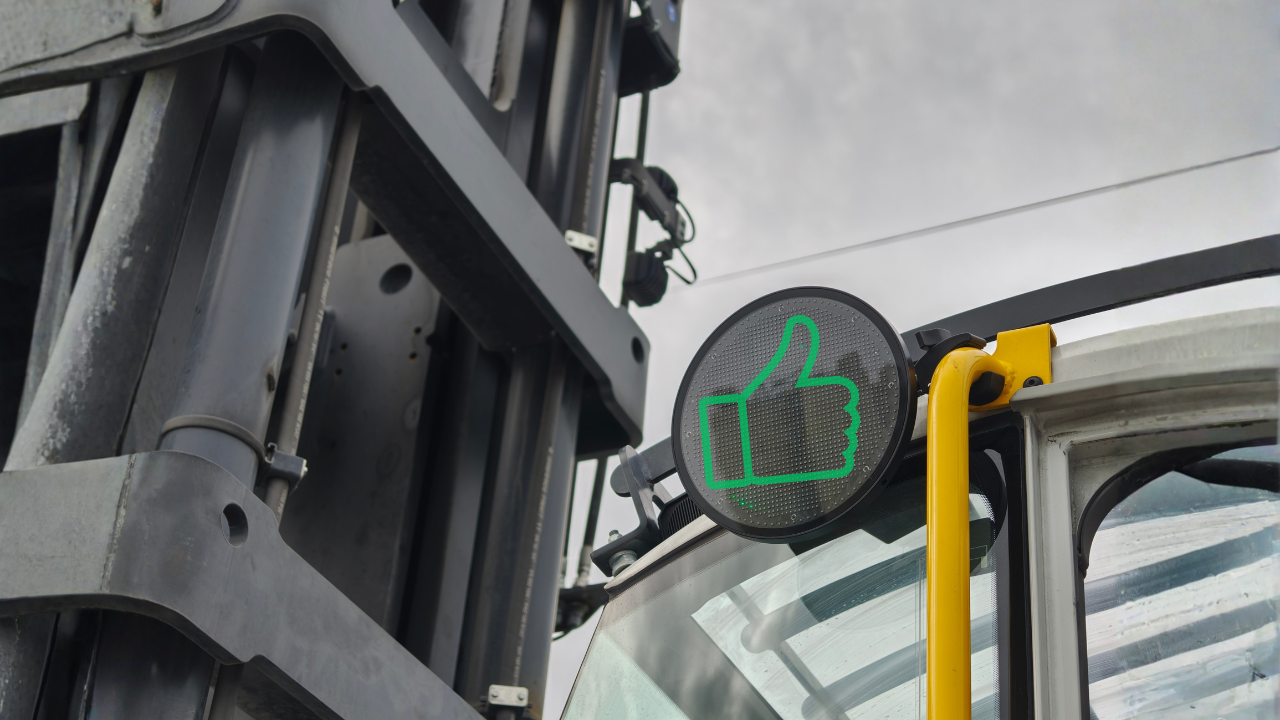
Recording, alerts and evidence
There is an optional recorder as well. Add the DVR and every camera channel is kept, live through TrafficAngel’s LiveDrive platform or downloaded later. That matters beyond the near miss itself. If something does go wrong, the footage is there for the investigation and for the insurer, and you can sit an operator down with a real clip rather than a description. Managers can set up an SMS or email that fires the moment a pedestrian is picked up close to a machine in motion, so the right person knows within seconds instead of hearing about it at the end of the shift.
Detection is one layer, not the whole answer
No camera makes up for a badly laid-out site. The Health and Safety Executive’s line is to keep people and vehicles apart first, with separate routes, marked walkways, barriers and designated crossing points, and to bring in warning and detection systems where you cannot fully separate them. Forklift pedestrian detection systems do their best work as one layer inside that plan. They cover the gap separation cannot, the moment a person and a forklift end up sharing the same ground anyway.
The PlantShield 360 System and HFR Camera System have made a measurable difference to safety and operational awareness across our site. With heavy forklift movement and multiple high‑risk pedestrian zones, we needed a robust solution that would enhance visibility, reduce blind‑spot hazards, and support our wider commitment to safe, efficient operations.
The integrated AI‑driven camera setup, combined with real‑time driver alerts and high‑quality video recording, has significantly improved how our operators manage pedestrian proximity, particularly around busy production outputs, stacked materials, and restricted‑visibility areas. The external cameras reliably detect pedestrians in high‑risk spaces, while the internal monitoring system helps reinforce positive driver behaviours and supports targeted coaching where needed.
The installation quality was exceptional. Despite space limitations in the vehicle cab and challenging cable‑routing pathways, the TrafficAngel team delivered a clean, professional fit with optimised camera placement, precise ECU and DVR mounting, and secure antenna positioning. Their attention to detail resulted in a reliable, durable system that integrates seamlessly with our daily operations.
Since implementation, we have seen enhanced driver confidence, improved pedestrian safety, and clearer visibility around heavy loads and blind spots. The recorded footage has already proven valuable for incident review, training, and continuous improvement. The PlantShield 360 System has become a key part of our risk‑reduction strategy and is a solution we would strongly recommend to any high‑activity industrial operation looking to strengthen its safety performance.
“The PlantShield 360 and HFR camera system have transformed safety on our site. The AI-driven pedestrian detection, clear driver alerts, and high-quality video recording have noticeably improved visibility around blind spots and high-risk areas. Installation was exceptionally professional, and the system integrates seamlessly with our daily operations. It’s a reliable, intelligent safety solution that delivers real value from day one.”
Forklift pedestrian detection systems for your site
The forklift pedestrian detection systems that work tend to do three jobs at once, detection that only reacts to people, alerts the operator can read and act on in the cab, and a way of signalling back to whoever is on foot. One product rarely covers all of that on its own, which is why it is worth thinking of it as a layered setup where each piece fills a gap the others leave.
TrafficAngel supplies, fits and supports PlantShield 360, its HFR camera system and Digital Thumbs Up from East Sussex, and will do a site assessment to work out what your operation actually needs. If forklifts and people share the floor where you are, call us on 01825 768555 and talk it through.
Contact UsFrequently asked questions
Yes. TrafficAngel supplies and fits PlantShield 360 to machines you already own, so there is no need to change your forklifts to add it. The number of cameras per vehicle is worked out for your site.
Cameras need enough light to see clearly, so a dark yard or a night shift is where they need a bit of help. TrafficAngel can add work lights, strobes or lightbars to keep the cameras effective after dark and to make the machine easier to spot on foot. Worth flagging in a site assessment if you run late or overnight.
No. Keeping people and vehicles apart comes first, with detection added on top as a second layer for the moments they still end up close. The HSE sets out what good separation looks like in its guidance on separating pedestrians and vehicles.


